Wednesday, September 22, 2010

SEZ documents cannot be kept confidential


The Bombay High Court has recently ruled that development of SEZs are of Public interest and the documents related to it cannot be kept confidential and it has to be public domain.

A division bench of Justice B H Marlapalle and Justice N D Deshpande was hearing a petition filed by SKIL Infra that had challenged the RTI commissioner's order asking Cidco to provide a Navi Mumbai resident with documents of the Navi Mumbai SEZ Pvt Ltd. The petition stated that the company had tied up with Cidco, the development authority, to set up the Navi Mumbai SEZ and the two had agreed on a deal that documents pertaining to this joint venture would be kept confidential.

The Bombay High court said that in a case where public interest was involved, a confidentiality clause between the Private Parties would not be applicable and documents would have to be made public.

Wednesday, September 15, 2010

FDI Rules governing JVs may be relaxed.


The Government of India has issued a discussion paper on FDI policy regarding foreign / technical collaboration in case of existing Joint ventures in India.

The purpose of this discussion paper is to solicit the comments and suggestion from public at large that any relaxation in FDI policy regarding JV & technical Collaboration / trademark agreement is required or not. This discussion paper also seeks the people’s views on the scope of relaxation.

The current move of Government of India is in furtherance of its continued effort to make FDI sector more attractive and investor friendly. Earlier, Government of India has also proposed relaxation of FDI policy in Multi-brand retail and in Defence sector.

Under the existing FDI regime, foreign investor, who entered into India before January 12, 2005 are not eligible for Automatic route for bringing in FDI, technology transfer or Trademark Agreement. It is necessary to take Government approval. Further, the foreign investor has to prove to the satisfaction of the government that the new proposal would not in any manner jeopardize the interest of existing joint-venture or technology / trademark partner or other stake holders.

However, the proposed relaxation of FDI policy shall not be applicable to Joint Ventures entered into after January 12, 2005. The reason behind it that as per PRESS NOTE 1 (2005 SERIES) all the Joint Ventures entered after January 12, 2005 are eligible for Automatic approval except in certain cases and also the onus to prove that the new joint venture shall not jeopardize the earlier one, is equally on Foreign & domestic companies. Further, the “Conflict of Interest” clause in JV could be embodied to safeguard the interest of Joint venture Partners.

The proposed relaxation aims at minimizing discrimination between foreign investors who had invested prior to 2005 and those who invested later. Further, the proposed relaxation shall promote healthy competition in this field and sustained long-term growth. Today the Indian industry is at par with its foreign counter-parts and hence there is absolutely no need of the clauses that brings onus only upon foreign investor that new proposal would not in any manner jeopardize the interest of existing joint-venture.

Thursday, September 2, 2010

Most favoured FDI Sector: Telecom


The telecommunication sector, including radio paging, cellular mobile, basic telephone services, is the most favoured Foreign Direct Investment (FDI) sector. The telecom sector has attracted $891 million FDI in April-May 2010-11, the first two months of current fiscal.

The Second most favoured is the service sector that attracted $578 million investment during the same period. Further, metallurgical industries and power sector clinched third and fourth place with an investment of $461 million and $313 million respectively.

This is the result of the continued effort of Government to make the FDI policy more attractive and investors friendly. Recently, Department of Industrial Policy & Promotion (DIPP) has invited comments/ suggestions on the consolidated FDI Policy - Circular 1 of 2010 by 31st August, 2010. It is also expected that DIPP shall release Revised Consolidated FDI Policy i.e., Circular 2 of 2010 on 30th September, 2010. The Revised Consolidated FDI Policy may introduce the more relaxed policy regarding FDI in Multi-Brand Retail trading and Defense Sector.

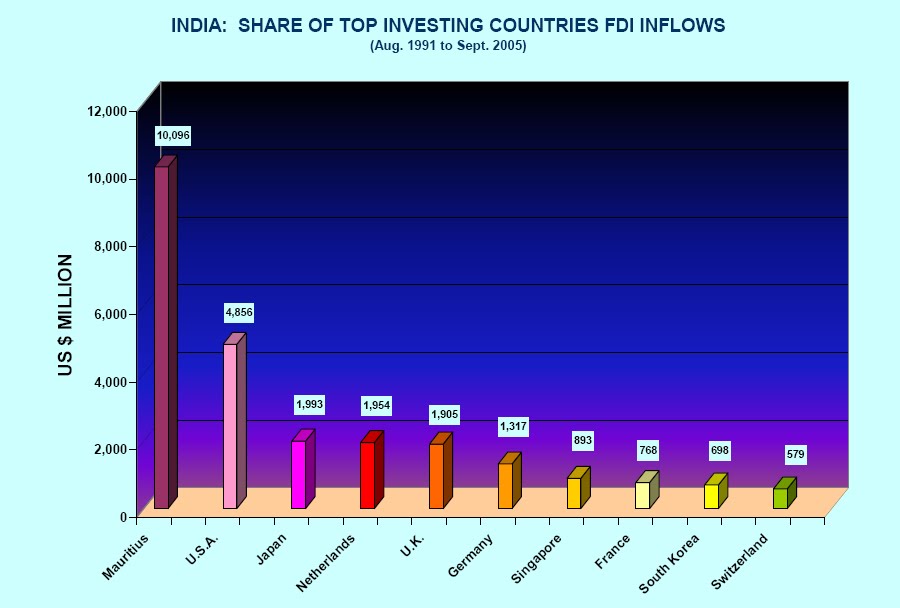
Further, according to the latest official data by the Government, Mauritius is again the top investing Country in India with an investment of $1.29 billion during April-May 2010-11. The other top investing Countries are Singapore ($854 million), Japan ($369 million) and the Netherlands ($298 million) for the same period.

Monday, August 30, 2010

Revised Consolidated FDI Policy


The nodal agency for foreign investment policy, Department of Industrial Policy & Promotion will release Revised Consolidated FDI Policy Circular i.e., Circular 2 of 2010 on 30th September, 2010, which will incorporate all the changes effected in FDI policy post issue of Circular 1 of 2010.

It is to be noted that the Department of Industrial Policy & Promotion (DIPP) has released the Circular 1 of 2010- Consolidated FDI Policy on 31.03.2010, effective from 01.04.2010.

Further, the Department has invited comments/ suggestions on the Circular 1 of 2010 by 31st August, 2010.

The Consolidated FDI Policy makes all information on FDI policy available at one place and subsumes Government’s policy on FDI announced through earlier Press Notes/ Press Releases/ Clarifications issued by the DIPP, which were in force and effective as on date. It was earlier decided that the consolidated FDI Policy would be issued every six (6) months to update the FDI policy.

It is expected that revised Consolidated policy would contain change in the policy regarding cigarette and cigar manufacturing and may introduce the more relaxed policy regarding FDI in Multi-Brand Retail trading, Defence Sector. The recent changes in FDI Policy shows that the government is making continued efforts to make the FDI policy regime more attractive and investor friendly.

Consolidated FDI Policy - Circular 1 of 2010 is available here.

India Singapore Tax Treaty: Tax waiver for Advisory services


The Authority for Advance Ruling (AAR) has recently held that the fees paid by Indian Company for technical services of a foreign Company will not be taxed in India under the India-Singapore Treaty (“Treaty”). The rationale given behind this decision is that advisory services such as comments and suggestions do not fall within the purview of the term ‘Fee for Technical Services’ under Article 12 of the treaty. This ruling of AAR came in the wake of the application filed by the Bharati AXA General Insurance Co. Ltd. (“BAGICL”) to know that if the foreign Company AXA ARC has any liability to pay tax in India in respect of the fee received from the BAGICL.

This ruling has come as a relief to those foreign companies who render support services so as to ensure uniformity and flawless quality in the business dealings of the group entities. Further, this ruling can provide some respite to the companies which do not have a permanent establishment in India as this ruling also state that the payment received by the companies having no permanent establishment in India cannot be taxed as business profits under the Treaty.

It has been noted that AAR has decided similar issues in the application filed by Ernst & Young Pvt Ltd (AAR No. 820 of 2009) on the above lines.

We would like to remind our readers that although the ruling is binding to the parties appear before the authority and the transaction in relation to which the ruling was given because the ruling was rendered on a set of facts and cannot be of general application. However, it may have persuasive value.

Thursday, August 26, 2010

FDI IN LLP


The Government may allow foreigners to set-up Limited Liability Partnership (LLP) in sectors where 100 % foreign investment is allowed.

The nodal agency for foreign investment policy Department of Industrial Policy & Promotion (DIPP), has written to the Ministry of Finance suggesting the broader scope in the proposed Foreign Investment framework for LLPs by allowing foreign Investment in LLPs with prior approval.

It is also expected that a discussion paper may be released in this regard in public domain so as to enable the Government to take an appropriate policy decision at the appropriate time.

It is important to note here that earlier this year after initial discussions, DIPP was not in favour of opening this form of entity for foreigners while the apex financial institution of the country's financial system Reserve Bank of India (RBI) as well as the finance Ministry has favoured FDI in LLP.

The Limited Liability Partnership (LLP) is viewed as an alternative corporate business vehicle that provides the benefits of limited liability but allows its members the flexibility of organizing their internal structure as a partnership based on a mutually arrived agreement

The Government has enacted Limited Liability Partnership Act, 2008, which extends to the whole of India.

Monday, August 2, 2010

Authority on Advance Ruling


The Finance Act, 1993, Chapter XIX-B of the Income Tax Act introduced the scheme of Advance ruling, which came into force from 1st June, 1993.

Advance ruling means written opinion or authoritative decision by an Authority empowered to render it with regard to tax consequences of a transaction or proposed transaction or an assessment in regard thereto.

The scheme of Advance ruling helps the non-residents and the residents having transaction with non-residents to bring the certainty of income tax liability and thus help them to plan their tax affairs in advance. It is faster and less expensive than litigation in the courts.


Following category of person can request for the advance ruling under Income Tax Act:
(i) Non-resident applicants
(ii) Resident applicants having residents having transactions with a non-resident.
(iii) Public sector companies

One of the salient features of the scheme of advance ruling is that it provides expeditious solutions to the income-tax problems. The time limit prescribed for the authority to pronounce its ruling is within 6 months from the date of receipt of the application.

Another important feature of this scheme is that it provides binding solution. Although the ruling is binding to the parties appear before the authority and the transaction in relation to which the ruling was given because the ruling was rendered on a set of facts and cannot be of general application. However, it may have persuasive value. It is important to note that no proceeding before, or pronouncement of advance ruling by, the Authority shall be questioned or shall be invalid on the ground merely of the existence of any vacancy or defect in the constitution of the Authority.


However, certain restrictions have been imposed on the admissibility of an application:

i. If the question is pending before any other authority;
ii. If the question related to the determination of market value of the property
iii. If the purpose of application is to avoid the income tax

Further, if the authority finds that the advance ruling pronounced by it, has been obtained by the applicant by fraud or misrepresentation of facts, the same may be declared void ab initio.

Eligible applicant can make a request for advance ruling in the prescribed form stating the question. The application should be accompanied by an account payee demand draft for requisite amount in favour of the Authority for Advance Rulings and made payable at New Delhi.

The application may be withdrawn within 30 (thirty) days from the date of the application.